Diamond and Gemstone School
Things you always wanted to know but forgot to ask about precious and semi-precious gemstones

Diamonds 101
If you’re thinking about buying a diamond, here’s a clear, beginner-friendly guide to help you understand what matters most—without the complicated and confusing jargon, to help you get the best diamond for your money. Check out the Pro-Tips for the best $ saving information!
01
Parts of a diamond
- The way a diamond is cut plays a huge role in how much it sparkles.
- Diamonds sparkle because they:
-
Bend light (refraction)
-
Reflect light inside (internal reflection)
-
Break light into colors (dispersion)
-
-
Shape affects style more than quality:
-
(Pro Tip- Round diamonds sparkle the most with 57-58 facets cut into them. Round, cushion oval and pear sparkle more than step-cut stones like emerald or baguette cuts)
-
Round – Most sparkle, most popular
-
Princess (square) – Modern and sharp
-
Oval – Looks bigger than it is
-
Cushion – Soft, vintage look
-
Old Mine or European- are diamonds cut before our round brilliant tools were used. They can have larger facets or less facets and larger culets (the point at the tip) than current stones.


02
What are the 4 C's
1. Cut (Most Important ⭐)
-
Controls how much the diamond sparkles
-
A well-cut diamond looks brighter—even if it’s smaller or darker
-
This is also the shape of the diamond
-
(Pro Tip- The cut can sometimes be the most important thing to your partner, asking what shape they love can help you choose the one that they are dreaming of!)
2. Color
-
Diamonds range from colorless to slightly yellow
-
(Pro Tip- (D-F are high quality but also very high cost due to their rarity)
-
Most people can’t easily see small color differences
-
(Pro Tip diamonds up to M are still bright and beautiful and can be as lovely as the higher letters saving you money)
3. Clarity
-
Refers to tiny flaws inside the diamond much like freckles or feathers
-
Many flaws are invisible without magnification, so you don’t always need “perfect”
-
(Pro-Tip- Most diamonds sold are "eye-clean" or SI quality SI inclusions are usually very small and will save you money over a high clarity stone
-
Inclusions are a good thing in a diamond. They are like a fingerprint with no 2 alike, making them easy to identify.
4. Carat (Size)
-
Bigger diamonds cost much more
-
(Pro-Tip-Slightly smaller sizes can save a lot of money with little visual difference for example a .97ct diamond looks just as large as a 1.01 but can be nearly $1000 less expensive )
03
Size of the stone in perspective
You will notice a .5 or 1/2 ct ring on the tip of her finger going up to 3.5ct or 3 1/2ct diamond at the top.
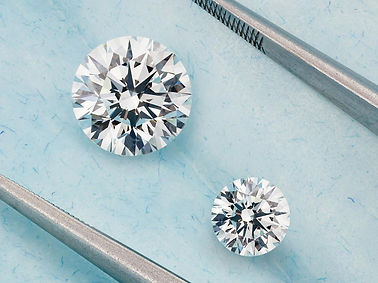
Most people will not purchase above a 1.5ct in a natural diamond but if the stone is lab-grown, it may be as large as 4ct. See below for information on lab-grown diamonds.

04
Lab-Grown Diamonds vs. Natural Diamonds
Natural Diamonds
-
Formed underground over billions of years
-
Rare and unique, just like your love
-
Great investment as they gain value
-
Great for heirlooms to someday pass on to your children or family
-
Usually more expensive but an engagement ring is something precious and s symbol of your commitment
Lab-Grown Diamonds
-
Made in labs (usually India or China) using technology
-
Look the same but can cost much less
* Good choice if you want better value for money or are happy to get them a real diamond later on an anniversary.
Pros and cons of lab grown diamonds-
Just the facts-
Pros- Lab grown diamonds are less expensive so you can afford a larger stone that a natural but there are many cons unfortunatly.
Cons-
**COST- lab grown diamonds are less expensive because they are not rare. When they came onto the market, they were created in mass amounts and today you an purchase your own machine.
**VALUE-Lab grown diamonds go down in value. For example a 3ct Lab grown stone could cost $1000 today but in a year it may only be worth a few hundred. Natural diamonds increase in value annually. When cubic zirconia came out in the 80's, they were new and exotic, fetching $200-300 per stone, now a CZ is worth pennies. Lab-grown diamonds are on that path as well.
**ENVIRONMENTAL- Lab grown diamonds are not better for the environment. The plants in China and India, mass producing them emit large amounts of toxins into the air, earth and water and with no EPA to oversee this pollution they create. The industry is under multiple lawsuits due to fictitious claims about being more sustainable.
Energy usage: Creating a single 1-carat lab-grown diamond typically requires between 250 and 750 kWh of electricity, though some methods can exceed 1,000 kWh. This intensive process, often running 24/7, uses energy equivalent to powering an average U.S. household for over three weeks to a month.
In contrast, natural diamond operations for mining, such as those by De Beers, often consume 80–150 kWh per carat, varying by site. jckonline.com
Carbon Footprint: Because many labs are located in India and China, which rely on coal-fired power, lab-grown diamonds can have a high carbon footprint, often emitting 511 kg of per carat.
jckonline.com
**CONFLICT- What about "blood diamonds"? In 2003, diamond companies, civil society groups, the UN & governments formed the Kimberley Process following diamonds to ensure that conflict diamonds don’t enter the global trade. This has been so successful that less than 1% of all natural diamonds have any conflict attached to them and that number is shrinking annually.
**Natural diamonds do good for the communities that support them. As much as 80% of the value of rough diamonds circulates within local communities through local purchases, employment benefits, social initiatives, building of schools, hospitals, roads and more. check out DiamondsDoGood.com
((We offer both natural and lab-crown options in our wedding jewelry and explain to customers that the value of the lab-grown stones goes down. We have had a few customers who paid $10,000 for a lab stone at other stores, thinking they were helping the planet, only to have them appraise for $200 today and dropping. Honesty and integrity are always best. We want our customers well educated. This is a large investment.))
What about Moissanite? -Moissanite is composed of silicon carbide, a material distinct from diamond at the atomic level. First discovered in a meteor crater in Arizona by French scientist Henri Moissan in 1893, moissanite is now nearly all lab-created because natural deposits are rare. **Diamonds are 10 on the hardness scale while moissanite is 9.25 making them a good choice for scratch resistance.
**Moissanite is sometimes less expensive than lab-grown diamonds and has more "fire" or "rainbows"
Much like lab-grown diamonds, moissanite doesn't hold value like the natural diamonds.
01
Colored Gemstones
Colored gemstones are natural minerals that come in many colors—reds, blues, greens, purples, and more. Unlike diamonds (which are usually clear), these gems are loved for their vivid colors and unique looks.
Some well-known gemstones include:
-
Ruby (red)
-
Sapphire (blue, but also other colors)
-
Emerald (green)
-
Amethyst (purple)
-
Other semi-precious gemstones you may see in jewelry include Opals and Pearls, Turquoise, Lapis Lazuli, Coral, Jade or Nephrite, Mother of Pearl and Labradorite to name a few.

02
Birthstones
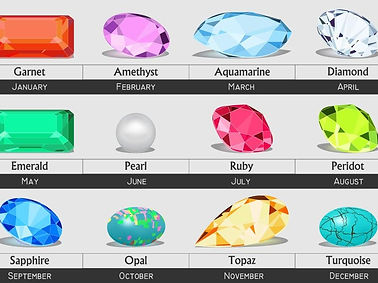
Here’s a simple guide to which gemstone matches each birth month:
-
January – Garnet
-
February – Amethyst
-
March – Aquamarine
-
April – Diamond (traditional, not colored) or white topaz
-
May – Emerald
-
June – Pearl or Alexandrite (alexandrite is very expensive due to it's rarity)
-
July – Ruby
-
August – Peridot
-
September – Sapphire (sapphires come in every color)
-
October – Opal or Tourmaline (tourmalines come in many colors)
-
November – Topaz or Citrine
-
December – Turquoise, Tanzanite, or Zircon (zircon looks very similar to blue topaz)
03
Gemstone care
How to Clean Gemstones (safe for most types)
For most common gemstones like diamonds, Amethyst, Citrine, and Topaz:
-
Use warm water + mild dish soap
-
Gently scrub with a soft toothbrush
-
Rinse well and dry with a soft cloth
👉 This works for many stones, but not all
Some gemstones are softer or more delicate, including:
-
Opal
-
Pearl
-
Turquoise
-
Emerald
For these:
-
❌ Avoid ultrasonic cleaners
-
❌ Avoid harsh chemicals
-
✔️ Clean gently with a damp cloth
-
✔️ Store carefully to prevent scratches
-
What to Avoid
-
Household cleaners (bleach, ammonia)
-
Hot water or sudden temperature changes
-
Wearing jewelry while:
-
Swimming 🏊
-
Cleaning 🧽
-
Exercising 🏋️
-
👉 Chemicals and impacts can damage or dull gemstones.
-
Store each piece separately (to avoid scratches)
-
Use a soft-lined jewelry box or pouch
-
Keep away from heat and direct sunlight
👉 Hard stones (like sapphires) can scratch softer ones!
Extra Tips for Long-Term Care
-
Have jewelry cleaned and inspected by a jeweler every 3-6 months
-
Remove rings before hands-on activities, cleaning or even sleeping
-
Put jewelry on after lotions and perfumes

Gold and Silver Jewelry Care Tips
If you’re thinking about buying a diamond, here’s a clear, beginner-friendly guide to help you understand what matters most—without the complicated and confusing jargon, to help you get the best diamond for your money. Check out the Pro-Tips for the best $ saving information!
01
Gold Jewelry Care
-
How to Care for Gold Jewelry
-
Gold is durable, but it can still scratch and lose shine over time.
-
Cleaning Gold
-
Mix warm water + a few drops of mild dish soap
-
Soak for 10–15 minutes
-
Gently scrub with a soft toothbrush
-
Rinse and dry with a soft cloth
-
Watch Out For
-
Gold (especially 14k or 18k) can scratch easily
-
Avoid chlorine (pools, hot tubs) → can weaken gold
-
Take off gold rings before heavy work
-
IMPORTANT NOTE!- Gold is a soft metal and can wear down over time with normal use. The tiny prongs which hold your stones in are especially susceptible to wear and after a while you may lose a stone!
**The first cause of wear and lost stones is from your bed. We recommend not sleeping in your jewelry. Chains stretch every night in your sleep and prongs can wear down quickly just by rubbing on the sheets.
**The second cause of wear and lost stones is chlorine, both by cleaning and by pool and hot tub use. Chlorine eats away gold rather quickly.
*It is important to make sure your rings are large enough to remove at night or before you clean, garden or do other activities that can put your jewelry at risk.
Another advantage to this is a healthier finger. Your finger can actually grow around your rings if they are never removed. We have seen customers in tears because they cannot remove their rings. All too often they are in need of a medical test and medical staff will ask you to remove all jewelry. It is frustrating to not be able to remove your rings for a procedure, We offer FREE ring removal (cutting) in case of this but recommend you keep your ring in a size large enough to remove for these situations. If the rings have to be cut off it is more expensive to repair and size them after the fact.
Our goal is to keep you in your treasured jewelry and to save you money on repairs by doing maintenance every 3-6 month. Cleaning and inspections are ALWAYS free and we can tighten any loose prongs while you wait.


02
Silver Jewelry Care
How to Care for Silver Jewelry
Silver (especially sterling silver) tarnishes—that dark, dull look over time especially with moisture in the air.
Cleaning Silver
-
Use a silver polishing cloth regularly
-
For deeper cleaning:
-
Warm water + mild soap
-
Gently clean and dry completely
-
👉 Special silver cleaners also work, but use them carefully as they clean by eroding away the surface and can be dangerous to handle and store.
Watch Out For
-
Tarnish happens faster with:
-
Air exposure
-
Humidity
-
Lotions, perfumes, sweat
-
What to Avoid
-
Harsh chemicals (bleach, cleaners)
-
Wearing jewelry while:
-
Swimming 🏊
-
Showering 🚿
-
Exercising 🏋️
-
-
Abrasive materials (paper towels, rough cloths)
-
Silver is not as soft as gold but can still scratch easily